
08 Jan 2026
There's a dangerous trend gaining momentum in boardrooms across the tech industry: companies laying off staff, cancelling SaaS subscriptions, and confidently declaring "we'll just build it with AI."
On the surface, it sounds appealing. Why pay £50K/year for a SaaS solution when AI can supposedly build it in a weekend?
Here's why this thinking is catastrophically short-sighted—and why we might be sleepwalking into a security and business continuity nightmare.
Let me pose a question that should keep every CTO awake at night:
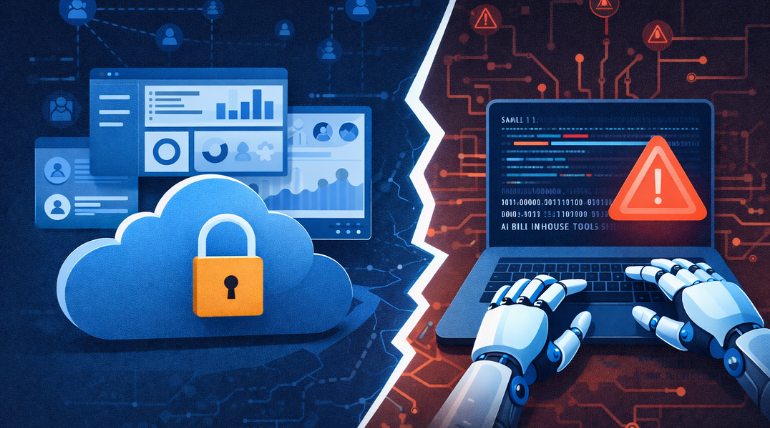
If an AI tool can build your solution that quickly, how easily can it hack the same solution?
Think about that for a moment. The same generative capabilities that let you rapidly prototype code also create predictable patterns, common vulnerabilities, and exploitable shortcuts. You're essentially building with a cookbook that every bad actor also has access to - and they're reading the same recipes.
Meanwhile, that SaaS solution you just cancelled? It's been battle-tested by thousands of penetration tests, security audits, and yes - actual attacks. Those vendors have spent years and millions of pounds hardening their systems against threats your team hasn't even imagined yet.
Your weekend AI project hasn't faced a single real-world threat. But it will.
Here's what you actually lose when you cancel that SaaS subscription and go it alone:
The collective wisdom of thousands of customers.
That feature you think is unnecessary? Three hundred customers requested it because they discovered a workflow your team hasn't encountered yet - but will.
That seemingly over-engineered authentication flow? It exists because 50 companies in regulated industries needed it to pass compliance audits. You'll discover why when your first enterprise deal requires ISO 27001 certification.
Those configuration options you find confusing? They solve real edge cases that you won't discover until you're deep into production with angry customers and it's too late to architect properly.
SaaS companies don't just build software - they aggregate years of feedback, failed experiments, and hard-won lessons from hundreds or thousands of deployments across industries you haven't sold into yet. They've already hit the problems you haven't thought of.
Your AI-generated solution is built on documentation and patterns. It has zero concept of messy reality.
Let's talk about what happens six months after you deploy your AI-built solution:
A new zero-day vulnerability is discovered in a library your AI chose (because it's popular, not because it's secure)
Your system needs to scale beyond what the initial architecture supports (spoiler: it won't)
Regulatory requirements change - GDPR fines just got steeper, and you're not compliant
You need integration with a system that didn't exist when the code was written
A customer asks "where's your SOC2 report?" and you realise you don't have one
Who's maintaining this? Who's monitoring the security advisories? Who's responsible when something breaks?
With SaaS, that's their full-time job. They have dedicated security teams, DevOps specialists, and compliance officers whose sole purpose is keeping the system secure and running.
You have... whatever engineers you didn't lay off, now maintaining AI-generated code they don't fully understand, alongside their actual jobs, whilst being told to "do more with less."
That's not efficiency. That's a disaster waiting for a convenient time to happen - probably at 2 AM on a bank holiday.
Yes, that SaaS subscription costs money. But let's calculate what you're actually comparing:
Enterprise SaaS solution: £50K/year
Maintained and updated continuously by a dedicated team
Security patches applied automatically (often before you even know there's a threat)
New features added based on feedback from hundreds of customers
Compliance certifications maintained and audited regularly
24/7 support with actual SLAs and financial penalties if they fail
Battle-tested by thousands of users across different industries and use cases
Your AI-built "equivalent":
Initial development: Maybe cheap (or "free" if you ignore opportunity cost)
Ongoing maintenance: Unknown - but someone's doing it
Security incidents: Potentially catastrophic (ICO fines start at 4% of global turnover)
Missing features discovered in production: Expensive to retrofit properly
Technical debt: Compounding daily
Opportunity cost: Your engineers building commodity features instead of your actual competitive advantage
Insurance premium increase: When your insurer finds out about your security posture
Customer trust: Difficult to quantify, impossible to recover
Which is actually more expensive? And which keeps you up at night?
Here's what's actually happening: companies are laying off experienced engineers who understand these systems inside-out, betting they can replace decades of expertise with AI.
But who's going to:
Review the AI-generated code for security flaws and architectural issues?
Design the system to scale beyond the initial use case?
Make the nuanced decisions about trade-offs between speed, security, and maintainability?
Debug production issues at 2 AM when the AI-generated code fails in ways the AI never anticipated?
Maintain institutional knowledge about why certain decisions were made?
Explain to the board why the system is down and customers are leaving?
AI is a powerful tool in the hands of skilled engineers. It's a liability in place of them.
If your business logic is so simple that AI can replicate your entire SaaS stack in a weekend, what exactly is your competitive advantage?
And if it's not that simple (spoiler: it isn't), why are you pretending it is?
Let's be honest about what's really happening here:
This isn't about innovation. It's about quarterly earnings calls and short-term thinking dressed up as technological progress.
CFOs see an immediate cost reduction. CTOs are under pressure to "prove AI value." And everyone's pretending that the long-term consequences won't land on their watch.
But they will. And when they do, the true cost will dwarf whatever was "saved."
I'm not anti-AI. I'm using it daily, and it's genuinely transformative when used appropriately.
But there's a universe of difference between:
✅ "AI can help our engineers be more productive on our unique value proposition"
❌ "AI can replace our engineers and all our specialised vendors"
Here's a radical thought: use AI to accelerate your core differentiators—the unique value that only you can build. For everything else, leverage the specialised expertise and collective wisdom that mature SaaS solutions represent.
The companies that will thrive aren't the ones that replace the most people and software with AI. They're the ones that use AI strategically whilst respecting the value of human expertise and battle-tested solutions.
Before you cancel that SaaS subscription or approve that next round of redundancies, ask yourself:
Are we building something truly unique to our business, or reinventing a commodity that someone else has perfected?
Do we genuinely understand the full scope of what we're taking on—including the bits we don't know we don't know?
Are we equipped to handle the security, compliance, and operational implications?
What happens when (not if) things go wrong? Who's accountable?
Are we making this decision based on long-term strategic value, or short-term financial pressure?
The allure of "free" AI-generated solutions is powerful. But in software, as in life, you usually get what you pay for.
Sometimes the most expensive decision is the one that looked cheap at the time.
We're potentially facing a wave of preventable security breaches, compliance failures, and business disruptions—all because companies convinced themselves that AI made expertise obsolete.
It doesn't. It never will.
The question is: will we learn this lesson before or after the disasters start piling up?